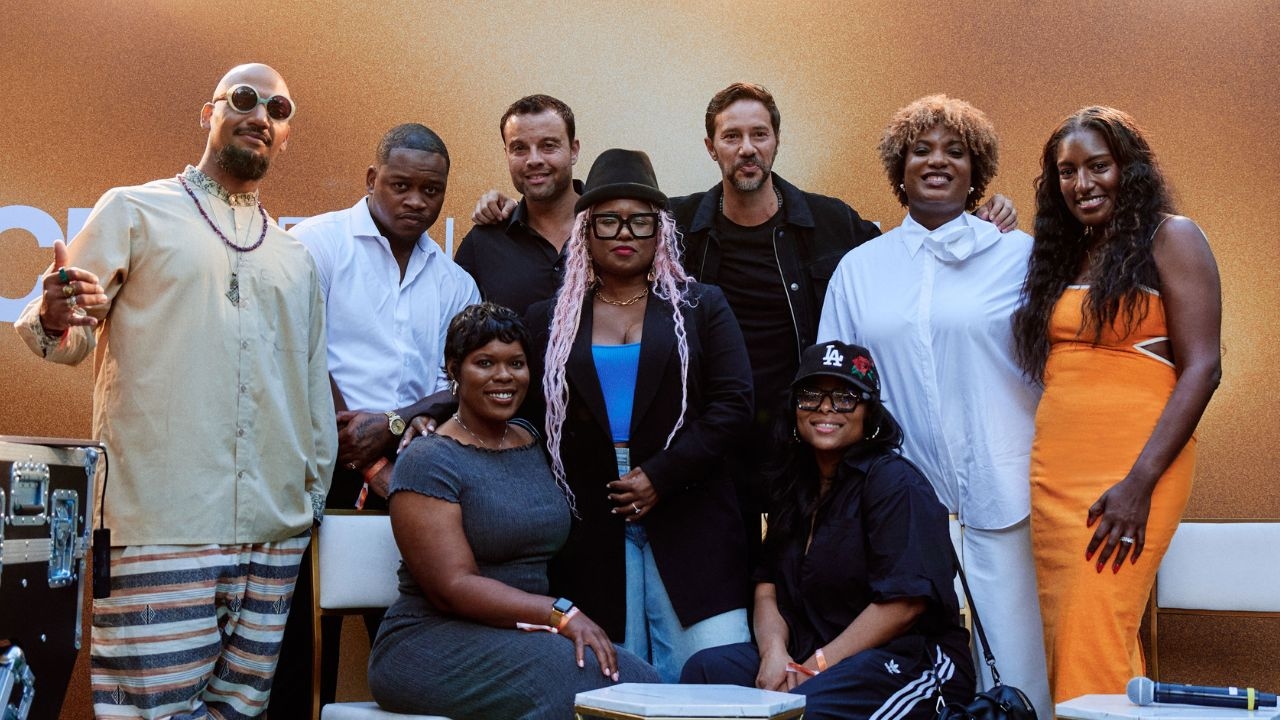
MACRO and Andreessen Horowitz’s Cultural Leadership Fund debuted work from the inaugural class of The Epigraph Creator Fellowship on July 30 at MACRO Foundation’s Summernight event in Los Angeles.
The program pairs culturally grounded creators with AI production tools. Announced in April 2026, it ran eight weeks and gave fellows direct access to platforms from OpenAI, ElevenLabs, Gamma, Promise Studios, Descript, Coactive and Curious Refuge, along with instruction on integrating each tool into their filmmaking process, the release states. Summernight served as the program’s public showcase.
The inaugural class includes Bianca Lambert, Chazitear Martin, John Burr, Justice Whitaker, Nick Barili, Sulayman Tahir and Tedra Wilson. Their projects have been featured in and recognized by the Tribeca Festival, the American Black Film Festival, Slamdance and the Essence Film Festival.
What the organizers said
In a statement, MACRO Chief Brand Officer Stacey Walker King said, “Storytellers have always led the way, setting the direction and shaping the culture. The Epigraph Creator Fellowship puts the power of today’s technology directly in their hands so they can expand and build the worlds they envision on their own terms. Technology doesn’t lead creativity. Creators do and now they have the tools to go even further.”
a16z Cultural Leadership Fund partner Judene Small Jean-Louis said in the same statement, “An epigraph frames meaning before the story even begins. We built this fellowship because creators and technologists are shaping storytelling in real time — but too often in silos. Epigraph brings them into the same room, creating real exposure on both sides and shifting how technology and culture come together.”
What the fellows said
“Participating in the Epigraph fellowship has opened doors not only in the world of AI filmmaking but also expanded my relationships in the rapidly growing tech community,” Justice Whitaker said. “Having hands-on access to top industry generative AI cinema tools gave me the opportunity and relationship with the technology to formulate a significant vision for how this technology can best be used to achieve my long-term goals. It also cultivated my creative ideation around the capabilities and purposeful use of these tools in my own creative practice. I look forward to developing further relationships with my mentors from both MACRO and a16z. Stacey King and Judene Small are inspiring, and I look forward to sharing more ideas and collaborating on more projects within the community of like-minded creative visionaries that have been brought together through the inaugural Epigraph Fellowship. It has been a joy and an honor to be a part of this cohort.”
Bianca Lambert credited the fellowship with making a previously unfundable project possible. “This experience has been genuinely revolutionary for me as both a filmmaker and a writer,” she said. “I’ve pitched this project to over six grant programs and been rejected from every one — so without these AI tools, this short simply would not exist. In practice, that means I can now bring this film to brands as a proof of concept for a partnership pitch: instead of a deck with static images, I can show characters walking, talking, and carrying a full story. That changes everything about how I pitch. The other thing I walked away knowing for certain is that these tools don’t work without a true creative vision behind them.”
For Chazitear Martin, the process was disorienting at first. “Oh my gosh, in the beginning, more times than not, I felt so uncreative and lost, I couldn’t find the feeling behind the prompt, and it was driving me insane,” she said. “One of the main reasons I love what I do is because of the way my work makes people feel. And luckily, the more I learned about prompting, the more I felt. My biggest takeaway was to stop trying to find soul in generative AI, and be the creative, and tell a vibrant, beautiful, emotionally detailed story, and your soul will shine through.”
Nick Barili said the fellowship reshaped how he thinks about independent film’s future. “When I began the Epigraph Creator Fellowship, I had very little experience using AI to tell stories,” he said. “Over the course of the program, I went from learning new tools to completely reimagining what independent filmmaking can look like. The hands-on experience of creating with AI accelerated my learning in ways I never imagined and opened my eyes to entirely new creative possibilities. My biggest takeaway is that AI has the potential to fundamentally reshape the entertainment industry by giving independent creators the ability to bring ambitious stories to life without waiting for a traditional Hollywood greenlight. Rather than replacing creativity, these tools can amplify it — and I’m excited to help shape that future.”
According to Sulayman Tahir, the tools only go as far as the vision behind them. “My biggest takeaway from the Epigraph Fellowship is that AI has the greatest impact when it’s integrated into a strong creative process,” he said. “Throughout the program, I discovered new ways to accelerate ideation, visualization, iteration, and world-building, allowing me to explore ideas at a scale and speed that wouldn’t have been possible otherwise. At the same time, the experience reinforced that every creative decision still depends on a filmmaker’s taste, instincts, and point of view. Rather than replacing the craft, AI expanded my creative toolkit and challenged me to think bigger, experiment more boldly, and approach storytelling in ways I hadn’t imagined before. I leave the fellowship with a deeper understanding of the technology and an even stronger belief that the most powerful use of AI begins with human vision.”
Tedra Wilson called for tech companies to go beyond software access. “The biggest takeaway for me with a focus on AI filmmaking specifically was realizing that AI is most powerful when it is guided by a clear human vision,” she said. “It requires character consistency, blockbuster movie appeal, fashion-forward costuming, bold cinematography, dynamic movement, color, sound, and, above all, a story that truly connects to my audience.”
She continued, “My experience in the Epigraph program reinforced that emerging technology is here to stay, and I’m especially interested in how Black creators can use it to build opportunities in industries where we have historically been underfunded and underrepresented. While subscriptions and free credits are appreciated, I would love to see more technology brands develop meaningful partnerships with Black creators that also include capital to move projects beyond experimentation and into production or higher learning in the space. As an independent Black woman filmmaker working with limited resources, seeing my ideas come to life through AI has made the possibility of expanding my original IP into a larger cinematic universe feel both real and achievable.”
