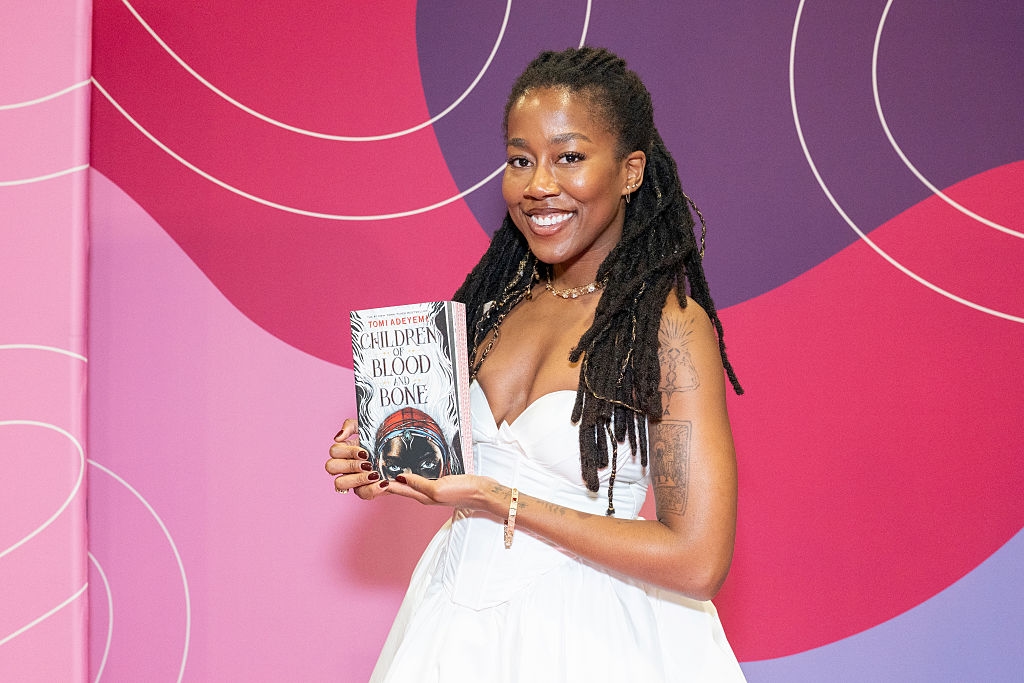
Tomi Adeyemi, author of Children of Blood and Bone, has publicly distanced herself from the film adaptation of her novel, even as the official trailer has been released and Paramount Pictures prepares for a January 2027 theatrical release. Her comments have reignited a familiar question in Hollywood: how much control do authors actually have over the film adaptations of their own books?
Book-to-film adaptations are common, from classics like The Color Purple and Waiting to Exhale to more recent titles like The Hate U Give and American Fiction. But Adeyemi’s recent comments about separating herself from her own project have drawn particular attention.
“What I’m about to share is not a secret to the people involved,” said Adeyemi in a since-deleted TikTok video. “It’s a reality that I’ve had to live with for about a year and a half, and everyone involved, at least at the highest level, has been made aware of this reality and they haven’t done anything to make it better.”
She added, “It’s become apparent to me that that reality needs to at least be made known, so that you guys can understand how this film, which I worked on to make it a little better for us to be alive, is also the worst thing I have ever had to live through, and I don’t wish to speak on it anymore.”
View this post on Instagram
She also responded to a comment under the video, where she stated, “I do not mind anyone going to watch the film. I wrote this for us. I fought for us. I’m just laying down my sword and officially separating my name because I can’t keep being hurt and attacked behind the scenes.”
We spoke with an expert to break down what actually happens, legally, when a book is adapted for film.
Optioning a book vs. selling its rights
Before anyone decides whether to adapt a book for film, something happens to determine whether a film can be produced from it.
“Essentially, an option gives a company the exclusive right to develop the book into a movie, seeing if there are attachments, a screenwriter, you know,” Reena Sehgal, Esq., entertainment and production attorney at Sehgal Law, told AFROTECH™ Culture in an interview.
View this post on Instagram
“It gives them a period of time to really try to work to see if a movie is even feasible,” she continued. “That’s why they don’t jump the gun and just purchase outright, because if they did, they may end up wasting their money if the movie is not possible.”
Sehgal is also the founder of Thoolie, a contract and education platform for independent filmmakers.
“Basically, what happened with Tomi in her original deal, they did revert back to her because she originally sold; that’s what the news was announced back in 2017, to Fox, which ended up being bought out by Disney, and then when Disney took over, Lucasfilm sat on their rights,” Sehgal explained. “They ultimately let the deal expire, so the rights were reverted back to her, which gave her the opportunity to try again.”
Once Lucasfilm’s rights lapsed, a competitive bidding war took place in January 2022, with studios like Universal, Netflix, Amazon and Paramount Pictures competing for the rights to Children of Blood and Bone.
Ultimately, Paramount won the war, agreeing to Adeyemi’s terms of a guaranteed theatrical release and allowing her to co-write the screenplay.
Hypothetically, could Adeyemi pull out from the film?
“You can’t pull out,” Sehgal answered. “I mean, unless they’ve violated some term of the contract the studio has in some way, or whoever the production company is, you don’t really have grounds to stop what they’re doing. If you have final cut or a significant degree of creative control in your contract, then you may be able to shift gears or force them to have to do things a certain way.”
She added, “But without that creative control, you’re really stuck with how the movie is ultimately going to be presented, but you have to remember that they’re not interested in buying IP to create a whole brand new universe. It’s a different medium. Film is [different] from the book world, so you have to adapt a little bit. There’s going to be some changes made, and a studio would never be interested in buying an IP, thinking I’m just going to pull two characters and drop them into a brand new universe when the audience is attached to the book that was already out there. So their intention is never to vary significantly from whatever was originally created. But creative decisions happen along the way. They have to deal with budgets. They have to deal with actors. They have to deal with the realities of filmmaking, and that does alter the ultimate story at the end of the day. And that can be upsetting to an author because it’s not being painted in the way that they’ve always envisioned it.”
If I’m an author, how should I approach the adaptation process?
Author of several books and the host of The Write Shade, Lawrence Ross, broke down more on the process of book-to-film or television adaptation in a YouTube video titled “I Didn’t Wanna Do This.”
“What happens when you have someone approach you for an adaptation? The very first thing you should do is vet them,” said Ross, who also holds an MFA in screenwriting from UCLA School of Theater, Film and Television, and currently has had a book in development as an adaptation for the past five years. “What have you done in the past? What is your artistic vision for types of works that are in your field? So, for example, if you’re talking about Black books, what have you done in the past? How have you portrayed your characters? What type of directors have you used in the past? What type of actors have you used in the past? What type of screenwriters have you used in the past?”
He added, “You want to vet them left and right because everyone will come up to you and say, ‘I think your think should be a book [film] but this is the part of your whole journey in an adaptation in which you somewhat have control because remember what they’re going to be doing is a little bit of a mixture of the book and a little bit of the film. They are going to be buying the TV and film rights of your book. You maintain the copyright of your book; however, when they buy the film and television rights, they now have a property, and this is the property that they see with themselves as the priority. Honestly, it actually might be for the best. Now, in Tomi’s position, if I remember correctly, she wrote at least one of the drafts of the screenplay. In a feature film, the name of the person who wrote the script is not the only person who wrote the script. There may be 9 writers on a particular script. You may have written the first draft; they may have said, ‘Thank you very much,’ and then there have been a series of writers who have come in to tighten up scenes, make the jokes funnier, give more drama, give more detail, punch up the dialogue; it’s a true collaboration.”
More on ‘Children of Blood and Bone’
Children of Blood and Bone is set to release in theaters on January 15, 2027.
The screenplay is by Tomi Adeyemi and Gina Prince-Bythewood, who also serves as the film’s director.
Children of Blood and Bone will star Thuso Mbedu, Damson Idris, Amandla Stenberg and Tosin Cole, alongside Cynthia Erivo, Lashana Lynch, Zackary Momoh, Richard Mofe-Damijo, Chiwetel Ejiofor, Regina King, Idris Elba and Viola Davis.
Also starring are Saniyya Sidney, Diaana Babnicova, Bukky Bakray, Ayra Starr, Shamz Garuba, Kola Bodunde, Pamilerin Afolake Ayodeji and Tèmítópé Fágbénlé